Monad
A security data-pipeline page on warm parchment: an 80px editorial serif headline, monospace for every UI string, pill buttons and a hand-drawn pipeline diagram glowing green at its hub.
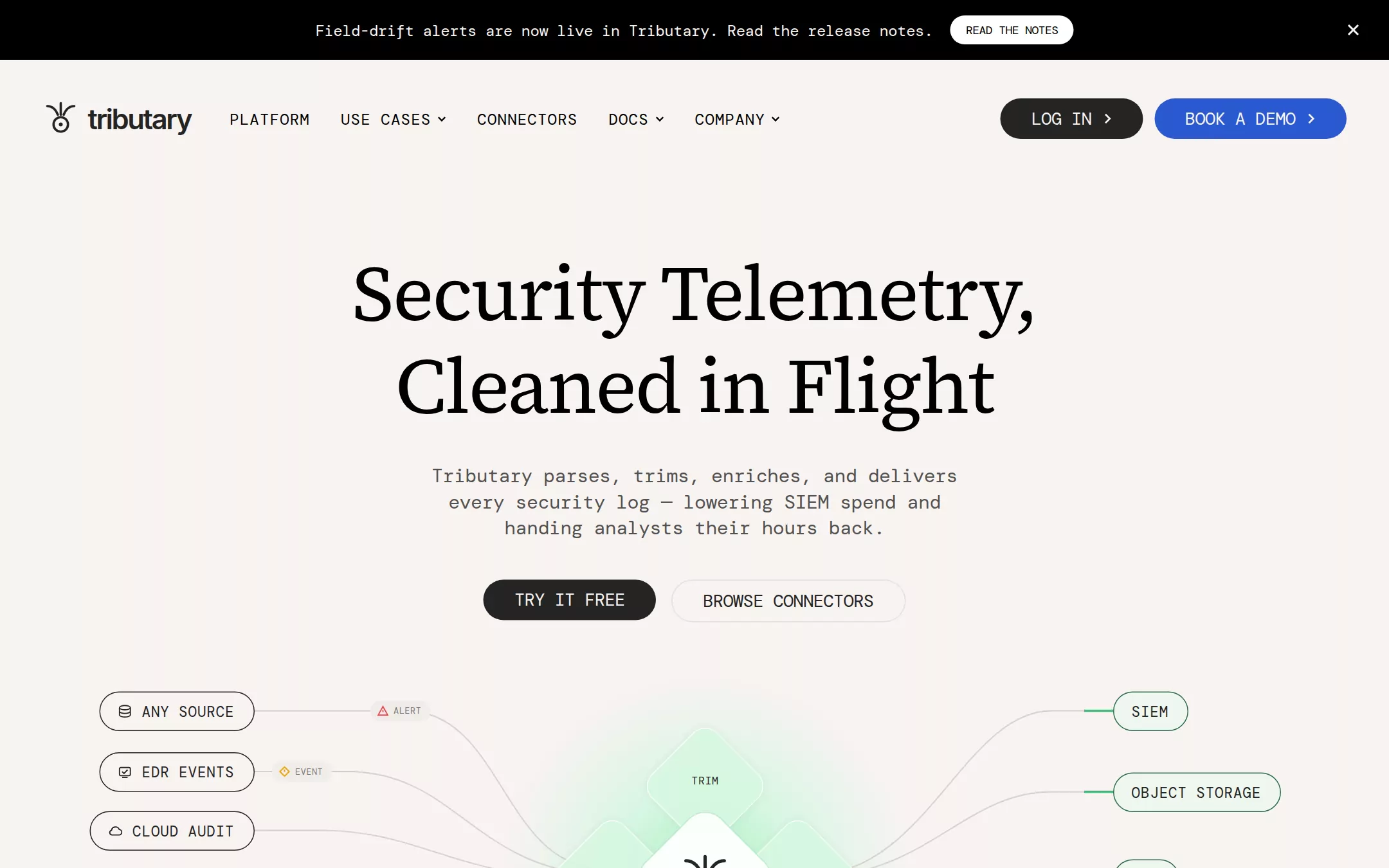
An original Tributary security-pipeline page: a black announcement strip with a white pill, a tall airy navigation with mono uppercase links and two pill buttons, a centred two-line 80px serif headline, a mono subtitle, a dark and a ghost pill button, a full-width pipeline diagram where bordered source pills curve into a green-glowing hub of four diamond tiles and fan out to green-tipped destination pills, a grayscale wordmark strip, a bordered 40px-radius card grid with one periwinkle feature card and a blurred coral-to-sky wash, an FAQ list of serif questions, a closing serif line and a hairline footer.
- Best forSecurity, observability and data-infrastructure products, developer-facing B2B platforms and any technical product that wants to read like a literary tech journal rather than a SaaS template.
- Tech stack- Next.js (App Router) - React - TypeScript - CSS custom properties Use Next.js App Router, React and TypeScript with plain CSS custom properties for every colour, radius, font stack and spacing token. Render the page as a server component — it needs no client state. Draw the logo mark, chevrons, node and tag icons and every diagram connector as inline SVG with fixed coordinates, and position the nodes, tiles and hub with absolute CSS inside a relative 1440px-wide diagram box, so the markup is deterministic between renders. The hub glow and the card wash are CSS radial-gradients with a blur filter, not images. Use local font stacks only — no remote font, image, logo or analytics host. Provide page metadata. Build and run the production page before capturing its preview.
The prompt. 1696 words, self-contained.
Build the "Monad" kickstart — A security data-pipeline page on warm parchment: an 80px editorial serif headline, monospace for every UI string, pill buttons and a hand-drawn pipeline diagram glowing green at its hub.

## Design
Build a rebrandable landing page for a security data-pipeline platform.

Create a complete landing page for Tributary, a fictional platform that collects security logs from every tool, parses, trims and enriches them in flight, and delivers each record to the right destination so teams pay less for their SIEM. Its core idea: an editorial tech journal printed on warm parchment — a serif that announces, a monospace that instructs, and one diagram as the only illustration. This is a concept presentation, not a real company — no real customers, people, investors or awards. Use original branding, artwork and copy throughout.

Color: a warm grayscale with colour used as punctuation. Parchment #F8F3F1 fills the whole page — never pure white. Ink #000000 is headline text and the announcement strip. Off-Black #242424 is the dark button fill, diagram node borders and secondary headings. Body and subtitle text is rgba(36,36,36,0.8) on Parchment; Graphite #4E4D4D is the solid equivalent; Smoke #797776 is only for 9px diagram tags and the footer. Ash #CECAC8 is every hairline: card borders, FAQ dividers, footer rule; diagram connector lines are a slightly lighter #D3CECB. Lake Blue #2B59D1 is the only saturated fill — the Book a demo button, the closing button and the focus ring — with Parchment #F8F3F1 text. Periwinkle Mist #CFDAF5 fills exactly one card. Decorative washes only, always blurred 50–75px: Coral #FF9473 and Sky #A0B5EB at 80% opacity behind the periwinkle card, Mint #A7FCCD with a stronger #76EC96 core as the diagram's radial hub glow. Signal green #3DBE7A marks only the destination line stubs; Coral marks the three flows nearest the hub. One barely visible shadow, rgba(0,0,0,0.06) 0 0 10px, on the diagram tiles only.

Typography: headings use "Source Serif 4", Georgia, "Times New Roman", serif at weight 400 — never bold — with letter-spacing -0.02em at every size: hero 80px/96px, section heads 48px/1.2, closing line 80px/96px, card titles and FAQ questions 24px/1.2. Everything functional uses "DM Mono", "JetBrains Mono", "IBM Plex Mono", ui-monospace, Menlo, monospace at weight 400: hero subtitle 20px/27px at -0.02em; buttons 18px uppercase at -0.022em; navigation links and eyebrows 16px uppercase at +0.05em; announcement copy 16px; diagram nodes 15px uppercase at +0.04em; tile labels 11px uppercase; tags 9px uppercase; small pills 12px uppercase. Card body copy alone uses "Inter", ui-sans-serif, system-ui at 16px/1.35, -0.02em. The wordmark is the same grotesk, weight 600, 29px, lowercase, -0.055em. Never mix serif and mono inside one sentence. Locally installed fonts only, no remote font request.

Shapes and spacing: buttons 100px radius, nodes, tags and pills 9999px, cards 40px with 40px padding, diagram tiles 18px. Page gutters 44px, content max 1432px, 16px element gaps, 64–128px between sections. Calm and spacious; hairlines, not shadows, separate things.

Announcement (id top): a full-width 62px Ink #000000 strip, centred: Field-drift alerts are now live in Tributary. Read the release notes. in 16px mono Parchment, 18px later a white pill READ THE NOTES in 12px uppercase Ink; a 14px × close icon 30px from the right edge.

Navigation: a 122px row, 44px side padding, transparent on Parchment, no border. Left: the logo mark — three thin strokes (two curves and a straight centre line) converging into a 15px ring with a dot inside, 38px, Off-Black 2.4px strokes — then the wordmark tributary. 40px later, the links PLATFORM, USE CASES ⌄, CONNECTORS, DOCS ⌄, COMPANY ⌄ in 16px uppercase mono Ink, 32px apart, chevrons as 10px line icons. Right: LOG IN › as an Off-Black pill and BOOK A DEMO › as a Lake Blue pill, both 42px tall, 32px side padding, 18px uppercase Parchment text, 12px apart.

Hero: centred. 72px under the navigation, the headline Security Telemetry, Cleaned in Flight at 80px/96px, max 800px wide so it breaks after the comma. 32px below, the 20px/27px subtitle Tributary parses, trims, enriches, and delivers every security log — lowering SIEM spend and handing analysts their hours back. in rgba(36,36,36,0.8), max 560px, three lines. 40px below, two pill buttons 16px apart: TRY IT FREE (Off-Black fill, Parchment text, 42px) and BROWSE CONNECTORS (transparent, 1px rgba(36,36,36,0.1) border, Off-Black text, 44px).

Pipeline diagram (id pipeline): 52px under the buttons, a full-width 440px-tall diagram drawn in inline SVG and absolutely positioned HTML. Left, right-aligned to x 264px, seven source pills stacked about 60px apart — ANY SOURCE, EDR EVENTS, CLOUD AUDIT, IDENTITY LOGS, NETWORK FLOWS, SAAS ACTIVITY, ASSET INVENTORY — each Parchment with a 1px Off-Black border and a 15px line icon (database, monitor with tick, cloud, person, pulse, window, list). From each, a 1.2px #D3CECB line runs right, then curves smoothly into the hub at the horizontal centre; the last 60px of the three middle flows turn Coral. On the lines sit four small tags — ALERT with a red triangle, EVENT with an amber diamond, FINDING with a grey shield, ASSET with a blue square — 22px pills in #F1ECEA. The hub, centred at x 731px, is a 420px radial Mint glow (#76EC96 at 62% fading to transparent by 72%), four 96px diamond tiles in rgba(214,246,224,0.92) with white 1px borders — TRIM above, PARSE left, DELIVER right, ENRICH below, labels upright in 11px mono — and a 112px white diamond in the middle holding the logo mark. From the hub, five lines fan right and flatten into five destination pills at x 1154px — SIEM, OBJECT STORAGE, XDR, DATA LAKE, ANY DESTINATION — with a deep-green #2E6B4A border on #EEF6EE and a 30px Signal green stub just before each pill.

Logo strip: 96px below the diagram, the eyebrow TRUSTED BY SECURITY TEAMS AT · SAMPLE in 16px uppercase mono, then six fictional wordmarks in Off-Black spread across the full width, each in a different style — Halvorsen (serif), northgate (bold lowercase grotesk), QUILLON (spaced mono capitals), Brightwater Co (light grotesk), Ferrous (serif italic), LUMA/OPS (bold grotesk).

How it works (id how): the 48px serif heading How Tributary works, then 64px below a three-column grid of 40px-radius cards with a 1px Ash border, 40px padding and 320px minimum height: Managed pipelines; a two-column-wide Periwinkle Mist card Transforms in flight with a blurred Coral-to-Sky wash bleeding off its top-right corner; Rule-based routing; Schema you can trust; Deploy your way. Each has a 24px serif title 64px from the top and 16px grotesk copy at 80% Off-Black, max 360px.

FAQ (id faq): a two-column row — the 48px heading Questions on the left third; on the right, full-width rows with 40px vertical padding, an Ash bottom hairline and no top border, each a 24px serif question with a 20px chevron at the right: How long does a new source take to connect? / Does Tributary store our log data? / Can we keep raw copies for compliance?

Closing (id closing): centred, 128px padding, the 80px serif line Less noise. Same signal. and below it BOOK A DEMO (Lake Blue) and BROWSE CONNECTORS (ghost).

Footer (id footer): a 1px Ash top rule, 64px by 44px padding, 14px mono Smoke text: © Tributary · a fictional sample on the left, Platform · Connectors · Docs · Security · Privacy on the right.

## Tech stack
- Next.js (App Router)
- React
- TypeScript
- CSS custom properties

Use Next.js App Router, React and TypeScript with plain CSS custom properties for every colour, radius, font stack and spacing token. Render the page as a server component — it needs no client state. Draw the logo mark, chevrons, node and tag icons and every diagram connector as inline SVG with fixed coordinates, and position the nodes, tiles and hub with absolute CSS inside a relative 1440px-wide diagram box, so the markup is deterministic between renders. The hub glow and the card wash are CSS radial-gradients with a blur filter, not images. Use local font stacks only — no remote font, image, logo or analytics host. Provide page metadata. Build and run the production page before capturing its preview.
Where the repo you are working in already has an equivalent in place, keep the repo's choice and say which one you kept.

## Everything else
Keep Tributary clearly fictional and rebrandable: no source wordmark, dotted-ring logo, customer logos, product names, copy or people; every wordmark is labelled sample. The page is Parchment #F8F3F1 everywhere, with Ink #000000 and Off-Black #242424 type and Ash #CECAC8 hairlines; Lake Blue #2B59D1 with Parchment text is the only saturated fill; Periwinkle Mist #CFDAF5 fills exactly one card; mint, coral and sky appear only as blurred glows and short line accents. Headlines are serif weight 400, never bold; every functional string is monospace. Headlines and the hero are centred; cards, FAQ and footer are left-aligned. Every link leads to a real section on the page; nothing submits or stores data. Content is initially visible — no scroll reveals or animated data flow; hover and focus are a 150ms opacity change, disabled for prefers-reduced-motion. WCAG AA contrast on every text/background pair, a visible 2px Lake Blue focus ring with a 2px offset, and a 360px layout without horizontal overflow, where the navigation collapses to the logo and Book a demo, the headline drops to 44px/52px, the diagram is replaced by a vertical list of sources, the four hub stages and destinations, and every grid becomes one column.

### Non-negotiables
- Responsive from 360px through desktop — no horizontal page overflow at any width. Deliberately scrollable regions stay within the viewport and remain keyboard and touch accessible.
- Every text/background pair clears WCAG AA (4.5:1 for body, 3:1 for large text); adjust a tint rather than shipping a failing pair.
- Fully keyboard operable, with a visible focus ring drawn in the accent colour.
- Honour `prefers-reduced-motion` — swap every transition for an instant state change.
- Write real copy in the voice described above; no lorem ipsum and no TODO placeholders.
- Use system or self-hosted fonts and CSS/SVG-drawn graphics — do not depend on a remote image or icon service.

Build the whole page end to end and show me the result running — not a description of it.