Modal
A near-black, faintly green developer page: a lime announcement strip, a quiet centred 44px headline with one lime phrase, pill buttons, and a glowing dot-matrix illustration rising out of the dark.
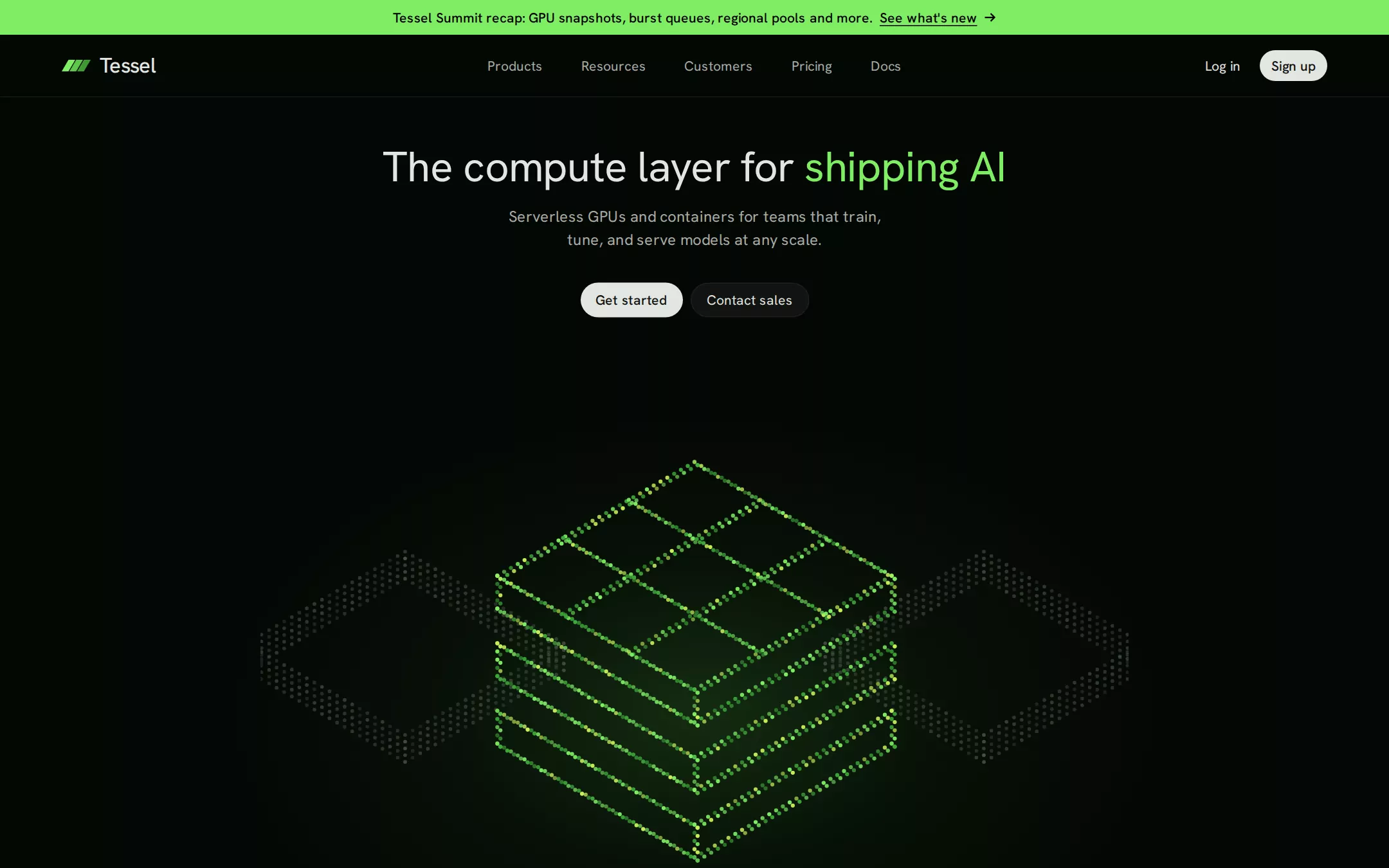
An original Tessel GPU-cloud page: a 36px Lime announcement strip; a 64px Void nav with a three-parallelogram mark, centred Sage pill links and a Phosphor Sign up pill; a centred 44px weight-400 headline with one Lime phrase over a two-line Sage lede and Get started / Contact sales pills; a glowing dot-matrix illustration of three stacked isometric slabs; a Trusted row of invented wordmarks; a Product band with pill tabs, feature copy and a DM Mono code window; Platform, Regions and Enterprise bands of line diagrams and mock UI; one pale Phosphor Customers band with a quote card; Updates; a closing call and a five-column footer.
- Best forAI infrastructure and GPU clouds, serverless compute, inference APIs, sandboxes for agents, developer platforms and any technical product that wants a dark, terminal-calm page with a single emissive hero image.
- Tech stack- Next.js (App Router) - React - TypeScript - Tailwind CSS Use Next.js App Router, React and TypeScript with Tailwind CSS; put every colour, radius and spacing value in the theme config as named tokens (void, ground, carbon, panel, phosphor, sage, moss, hairline, lime, lime-ink, forest) so no raw hex appears in a component. Render the page as a server component; only the Product tab stack and the Customers prev/next carousel are small client components. Load Hanken Grotesk (400, 500) and DM Mono (400) through next/font/google with the latin subset and display swap. Generate the hero dot-matrix illustration as inline SVG at build time from a small deterministic function (seeded, so server and client render identically) — no canvas, WebGL or remote image. Draw the mark, wordmarks, icons, diagrams and mock UI as inline SVG or HTML. Provide page metadata. Build and run the production page before capturing its preview.
The prompt. 1655 words, self-contained.
Build the "Modal" kickstart — A near-black, faintly green developer page: a lime announcement strip, a quiet centred 44px headline with one lime phrase, pill buttons, and a glowing dot-matrix illustration rising out of the dark.

## Design
Build a rebrandable landing page for a serverless GPU and container cloud for AI teams.

Create a complete landing page for Tessel, a fictional compute platform where developers decorate a Python function and get autoscaling GPUs, sandboxes, batch jobs and inference endpoints. Its core idea: a near-black, faintly green terminal-like page, quiet and text-led, whose one image is an emissive dot-matrix illustration glowing lime out of the dark, and whose middle alternates near-black bands of product UI with one pale Phosphor band of customer stories. This is a concept presentation, not a real company — no real customers, people, metrics, logos or quotes. Use original branding, artwork and copy throughout.

Color: Void #040804 is the page canvas and hero — a black with a trace of green, never pure #000000. Ground #10120F and Carbon #131412 are the alternate dark bands; Panel #1A1C19 fills cards, code windows and mock UI. Phosphor #E3E5E1 is every heading, nav label for the active state and the primary pill button fill. Sage #A8ABA6 is all body copy, ledes and inactive nav links; Moss #6C6E6A is captions, menu column labels and code comments. Hairline #2A2D29 is every divider and card border (on Void it may be written rgba(255,255,255,0.07)). Lime #7FEE64 is the signal: the announcement strip fill, the hero's highlighted phrase, section eyebrows and the dot-matrix art — never body text and never a button fill in the page body. Text on Lime is #10120F. Forest #124F11 is the eyebrow colour inside the pale Customers band. No blue, purple or other hue outside the four tiny region dots in Regions.

Typography: "Hanken Grotesk", "Inter", system-ui, sans-serif for everything (Hanken Grotesk is free on Google Fonts), weights 400 and 500 only — headings are 400, never bold. Hero h1: 44px/48px weight 400, -0.01em, one centred line. Section h2: 37px/44px weight 400, -0.01em, left-aligned, at most two lines. Ledes and card titles: 16px/24px. Nav links and buttons: 14px/24px, buttons weight 500. Small feature copy, captions and menu labels: 13px/20px with +0.01em tracking. Eyebrows: 12px/20px weight 500, +0.03em, Lime, after an 18px rounded tinted square icon. "DM Mono" (Google Fonts) 13px/22px sets code windows and mock UI values only.

Shapes and spacing: a 1312px content column (64px gutters at 1440px). Radii: 48px for every pill (buttons, nav links, tab chips), 8px for cards, code windows and mock panels, 4px for tags. No drop shadows anywhere; depth comes only from surface steps (Void → Ground → Carbon → Panel) and 1px Hairline borders. Bands carry 144px top and 120px bottom padding.

Announcement: a 36px full-width Lime strip, centred 14px/500 #10120F text — Tessel Summit recap: GPU snapshots, burst queues, regional pools and more. — then an underlined See what's new link with a 14px arrow, 8px apart.

Navigation: a 64px bar on Void with a 1px Hairline bottom border, 1312px wide. Left: the Tessel mark — three slanted Lime parallelograms stepping from #7FEE64 to deeper greens — and a 22px weight-500 wordmark. Centre: Products, Resources, Customers, Pricing, Docs as 14px Sage pills with 16px side padding. Right: Log in in Phosphor text and Sign up as a 32px Phosphor pill with #10120F text.

Hero (id top): 48px below the nav, the centred h1 The compute layer for shipping AI with shipping AI in Lime; 16px below, a 410px Sage lede over two lines: Serverless GPUs and containers for teams that train, tune, and serve models at any scale. 32px below, two 36px pills 8px apart: Get started (Phosphor fill, #10120F text) and Contact sales (rgba(255,255,255,0.05) fill, faint ring, Phosphor text). Below, centred and filling the rest of the first screen, an original inline-SVG dot-matrix illustration: three stacked isometric slabs drawn only in 2px dots in Lime and two deeper greens, the top slab's face tessellated into a 3×3 grid, flanked by two dim grey dot-matrix diamond outlines at 25-50% opacity, all over a soft radial green glow on Void.

Trusted: the hero's bottom 140px, above a Hairline rule: a 13px Sage caption Trusted by teams shipping models daily with its last two words in Phosphor and a vertical divider, then a row of seven invented 19px grey wordmarks — northwind, PARCELO, quillstack, lumen/ops, Fernbank, orbitly, HALCYON.

Product (id product): eyebrow Product and the h2 Containers that boot before your coffee cools. 96px below, three columns: a 166px vertical stack of 34px pill tabs with 16px line icons — Inference (active: rgba(255,255,255,0.05) fill and faint ring), Training, Sandboxes, Batch; a 450px copy column with a 16px Phosphor title, a Sage lede and a 2×2 grid of 13px feature heads and Sage lines; and a 499px-tall Panel code window with three 8px grey dots and a DM Mono snippet (keywords Lime, strings Phosphor, comments Moss). A 36px Phosphor Learn more pill sits under the copy.

Platform (id platform): a Carbon band: eyebrow Platform, a two-line h2 Compute rebuilt for the shape of AI work and a Learn more pill, then three numbered columns split by Hairline verticals, each a thin line-art isometric diagram with four coloured corner nodes over a 16px title and a 14px/24px Sage line.

Regions (id regions): a Ground band: eyebrow Capacity, h2 Capacity that follows your traffic, and a dark dotted world grid with small 12px/500 region labels; under it four columns of 14px titles and Sage lines.

Enterprise (id enterprise): eyebrow Built for enterprise, a two-line h2 Production-ready from the first deploy on the left and a 424px 16px Phosphor paragraph on the right, then three 8px-radius Panel cards with Hairline borders holding mock UI — an audit log table in DM Mono, a containers chart and a live GPU usage card — each over a 14px title with a line icon and a Sage paragraph.

Customers (id customers): the one light band, Phosphor #E3E5E1 with #10120F type: a Forest eyebrow Customers, a large 8px-radius card with a 28px/36px quotation from an invented customer and a geometric scatter of small grey and coral isometric glyphs, round prev/next buttons top right, and a 4×2 grid of 8px tiles holding invented wordmarks.

Updates (id updates): a Phosphor band continued: eyebrow Blog, h2 Latest updates and three post cards with a 4px tag, a 16px title and a Moss date.

Closing call (id start): a Void band with a green glow at the lower left: a two-line 44px h2 Ship your first endpoint today with your first endpoint in Lime, Get started and Contact sales pills and a 13px Sage note $30 a month of free compute.

Footer: Void, a 22px wordmark left, then Products, Solutions, Resources, Tools and Company columns of 14px Phosphor heads over 14px/24px Sage links, a Hairline rule, five 22px round social glyph buttons, Privacy and Terms links and © Tessel — a fictional sample product.

## Tech stack
- Next.js (App Router)
- React
- TypeScript
- Tailwind CSS

Use Next.js App Router, React and TypeScript with Tailwind CSS; put every colour, radius and spacing value in the theme config as named tokens (void, ground, carbon, panel, phosphor, sage, moss, hairline, lime, lime-ink, forest) so no raw hex appears in a component. Render the page as a server component; only the Product tab stack and the Customers prev/next carousel are small client components. Load Hanken Grotesk (400, 500) and DM Mono (400) through next/font/google with the latin subset and display swap. Generate the hero dot-matrix illustration as inline SVG at build time from a small deterministic function (seeded, so server and client render identically) — no canvas, WebGL or remote image. Draw the mark, wordmarks, icons, diagrams and mock UI as inline SVG or HTML. Provide page metadata. Build and run the production page before capturing its preview.
Where the repo you are working in already has an equivalent in place, keep the repo's choice and say which one you kept.

## Everything else
Keep Tessel clearly fictional and rebrandable: no real company, logo, mark, customer, testimonial, person, metric or copy; every name is invented and the footer says so. Every link leads to a real section on the page. Content is initially visible — no autoplay, parallax, scroll reveal or animated dot field. Hover and focus: nav pills and tab chips gain a rgba(255,255,255,0.05) wash over 150ms, the Phosphor pill lightens to #F1F2EF, and transitions stop for prefers-reduced-motion; every control shows a 2px #7FEE64 focus ring with a 2px offset. WCAG AA contrast on every text pair: Phosphor and Sage on Void, Carbon and Panel; #10120F on Lime and on Phosphor; Forest on Phosphor. Moss is used only at 13px for non-essential captions on Void. At 360px the announcement wraps to two centred lines, the nav collapses to the mark, a Menu button and Sign up, the h1 drops to 32px/36px over two lines, the dot-matrix art scales to the viewport width, the Trusted row wraps under its caption, every multi-column grid becomes one column with the code window below its copy, and nothing overflows the page horizontally.

### Non-negotiables
- Responsive from 360px through desktop — no horizontal page overflow at any width. Deliberately scrollable regions stay within the viewport and remain keyboard and touch accessible.
- Every text/background pair clears WCAG AA (4.5:1 for body, 3:1 for large text); adjust a tint rather than shipping a failing pair.
- Fully keyboard operable, with a visible focus ring drawn in the accent colour.
- Honour `prefers-reduced-motion` — swap every transition for an instant state change.
- Write real copy in the voice described above; no lorem ipsum and no TODO placeholders.
- Use system or self-hosted fonts and CSS/SVG-drawn graphics — do not depend on a remote image or icon service.

Build the whole page end to end and show me the result running — not a description of it.